
Community & legal
Terms, privacy & cookies
A reader's guide to the three legal pages: who sees what, how long things are kept, your data and your account.
The three pages
Three pages, linked from every footer and from both registration forms, say what this deployment does with what it holds: the Terms of Use (what the service is, what is public, your responsibilities, community content), the Privacy Policy (what is collected, who sees it, how long it is kept, your rights) and the Cookie Policy (the four cookies, all strictly necessary, so there is no consent banner). Creating an account through either registration form records the moment you agreed to the Terms. This page is a reader's guide to them, not a substitute: the policies are the text that counts.
Who sees what, in one table
| Thing | Who can see it |
|---|---|
| A private sensor (the default) and its readings, rules, maps and pages | Members of its group, as far as their permissions reach; a holder of the sensor's read token for the readings. |
| A sensor marked Public | Anyone, through the public analytics page, the open data API and any map, page or dashboard it is placed on. |
| A sensor listed on the open map | Anyone, including search engines — name, coordinates, notes, variables, health and a week of readings. |
| A map, analytics page or dashboard shared by link | Anyone holding the link (and the password, when one is set); shared pages ask search engines not to index them. |
| A group's public site | Anyone; it lists only the group's publicly shared pages. |
| Community posts, comments and pictures | Anyone on the internet, with your username — the board is a public page and search engines are allowed to index it. Writing needs an account; reading needs nothing. |
| Alert recipients' addresses and numbers | Members who can edit the rule; never public, never sent to a language model. |
| Your account details, second-factor and phone | You and the operators of this deployment. |
How long things are kept
Sensor readings, QC decisions and rating curves are the record and are kept until the owner deletes the sensor. Operational records age out on a schedule the privacy policy states: alert delivery records after 180 days, incidents and alert events after two years, assistant conversations and the audit log after a year, model diagnostics after 90 days. Backups are encrypted and replicated to a second server.
Your data and your account
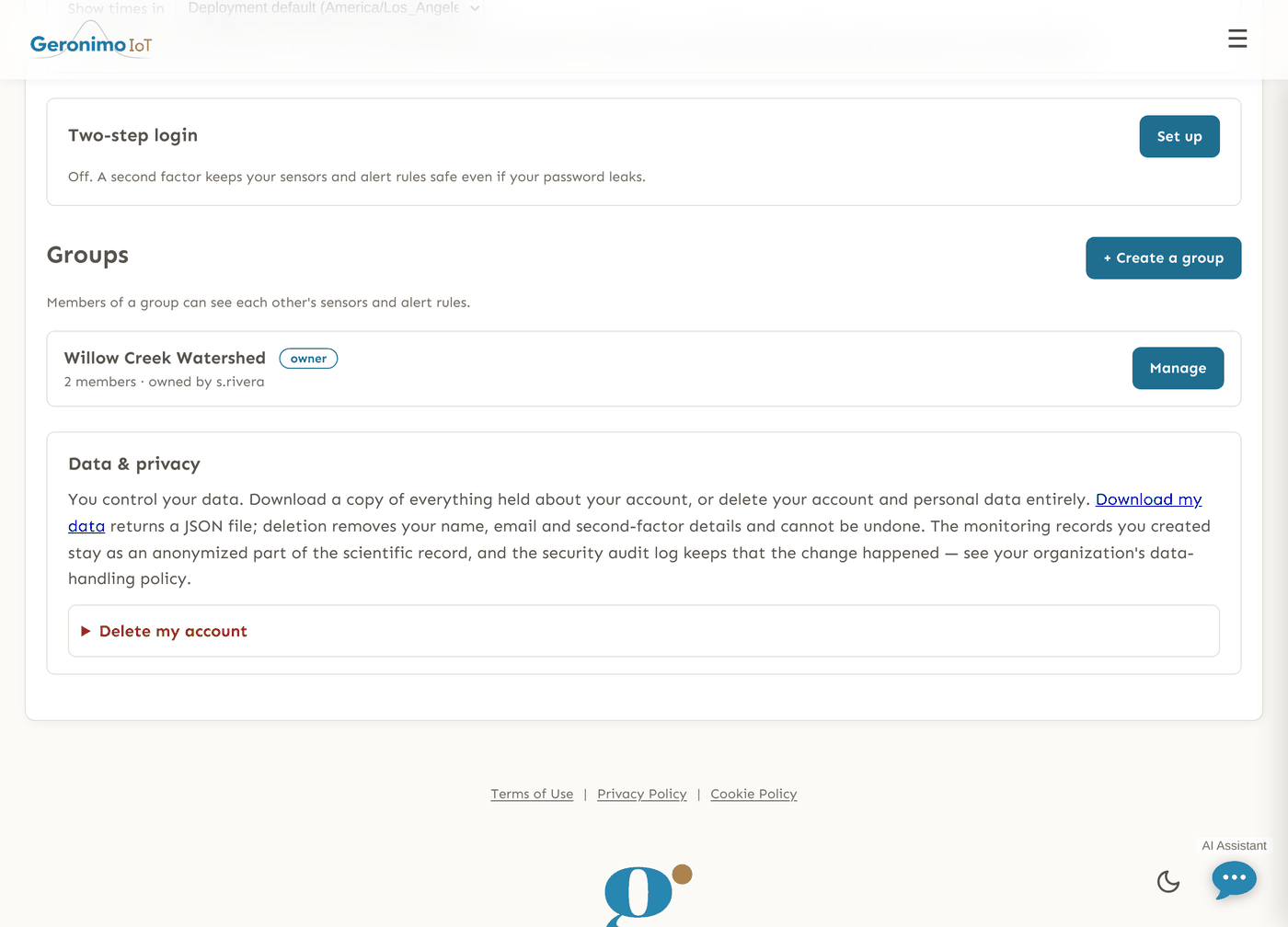
Your profile → Data & privacy has Download my data (a JSON file of everything held about your account) and Delete my account (removes your name, email, phone and second-factor details; your community posts, comments, pictures and votes are deleted with the account, while the monitoring records you created — sensors, rules, QC decisions, notes — stay, re-attributed to an anonymous placeholder, because the group's record depends on them). The guest account can do neither. Questions go to the contact address on the policies.